Rickshaw drivers start their day early and finish late. Their three-wheeler is their shop, their office, and their source of daily bread. But a rickshaw also drinks a lot of petrol. A driver running all day can burn 8 to 12 litres daily, making fuel the biggest cost of his work.
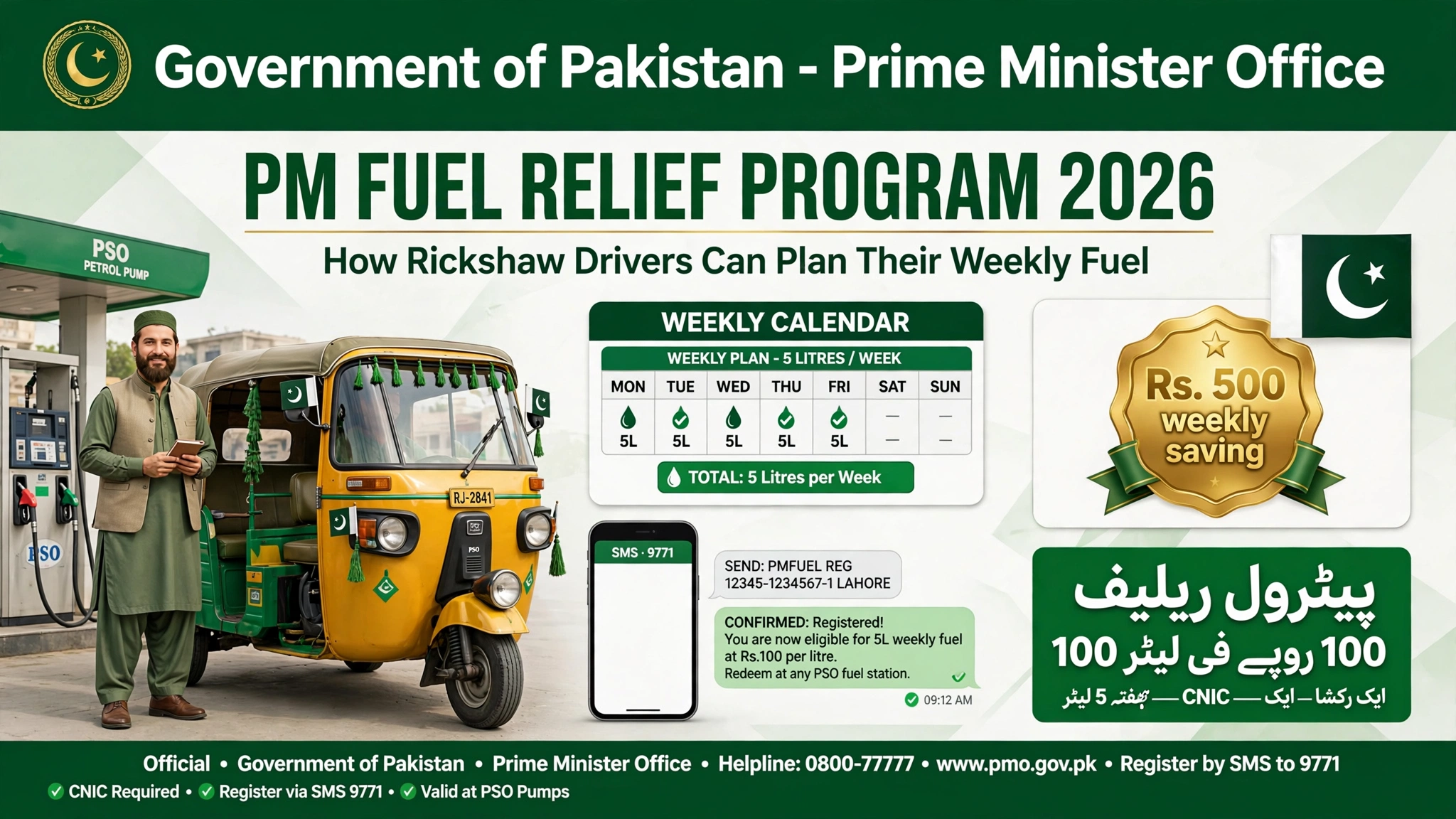
The PM Fuel Relief Program 2026 includes rickshaw and Qingqi owners in the 20-litre monthly quota. With Rs. 100 relief per litre, a driver saves a fixed Rs. 2,000 every month. Since rickshaw fuel comes in weekly portions, planning fuel week by week is the smartest way for drivers to get the full benefit.
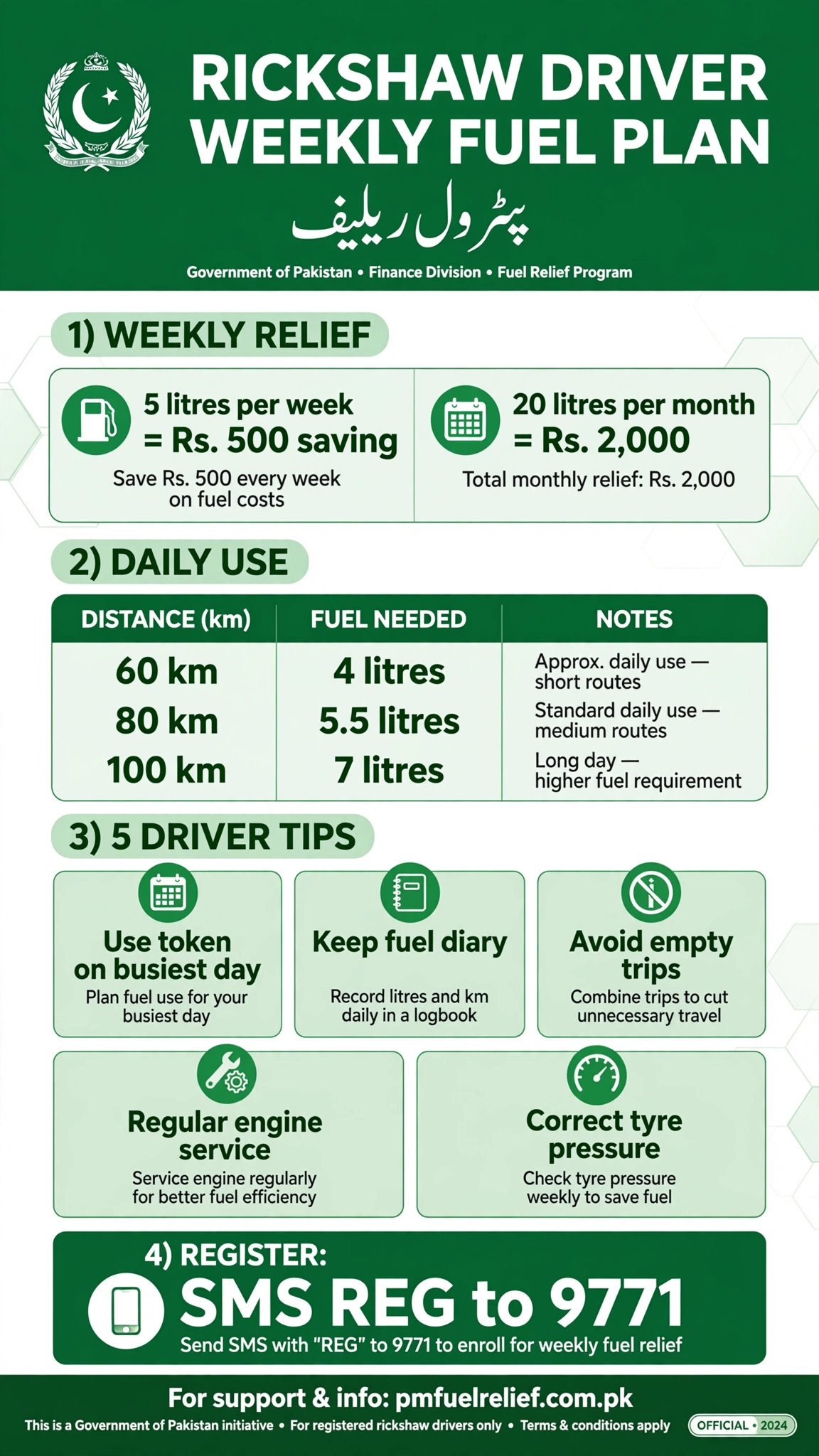
| Daily Rickshaw Running | Petrol Used Daily (approx.) |
|---|---|
| 60 km per day | 4 litres |
| 80 km per day | 5.5 litres |
| 100 km per day | 7 litres |
| 120 km per day | 8 litres |
| 150 km per day | 10 litres |
Why Weekly Fuel Planning Matters for Rickshaw Drivers
Most rickshaw drivers think in days and weeks, not months. They earn daily and spend daily. The scheme’s monthly quota is therefore best understood as a weekly plan.
- 20 litres a month means 5 litres per week of relief fuel.
- 5 litres at Rs. 100 relief saves Rs. 500 every week.
- For a driver, Rs. 500 is one full day of extra earning kept safe.
- Weekly planning matches how drivers actually earn and spend.
When you see it as Rs. 500 saved every week, the benefit feels real and close. It is money you do not have to earn extra.
How the Weekly 5-Litre Token Works
Your 20 litres come as 4 weekly tokens of 5 litres each. Each token is like a small weekly gift of cheap fuel.
At the start of each week, send TOK to 9771 and get your token. Take it to the petrol pump and fill 5 litres with relief. A rickshaw doing 80 km daily uses about 5.5 litres a day, so one token covers roughly one full working day of cheap fuel.
Use the token on your busiest day, for example a market day or weekend, when you will drive the most kilometres. That way the cheap fuel works the hardest for you.
Matching Fares With Fuel Costs
One big problem for rickshaw drivers is that fares do not rise as fast as petrol prices. Passengers argue over every ten rupees, while the driver’s fuel cost keeps climbing.
- When petrol rises, do not immediately fight with passengers over fares.
- First claim your Rs. 500 weekly relief, which softens the price hit.
- Explain politely to regular customers if a small fare adjustment is needed.
- Focus on busy routes where you get more passengers per litre.
- Avoid empty return trips by waiting a few minutes for a return passenger.
The relief gives you breathing room. Instead of raising fares sharply and losing customers, you absorb part of the fuel rise through the scheme.
Daily Fuel Diary: A Simple Driver Habit
Successful drivers keep track of their fuel. A small notebook in the rickshaw can save thousands of rupees.
Each evening, write two numbers: kilometres driven and litres filled. At the end of the week, you will see your real average. If your rickshaw gives 14 km per litre one week and 12 the next, something needs attention, maybe the air filter or spark plug.
This diary also helps you plan tokens. When you know you will drive 100 km on Friday, you save your weekly token for that day. Drivers who track fuel always spend less than those who guess. More practical tips are shared on pmfuelrelief.com.pk.
| Weekly Check | What It Tells You |
|---|---|
| Kilometres per litre | Whether the engine needs tuning |
| Litres filled per week | How fast the quota is used |
| Token used or missed | Whether Rs. 500 was saved |
| Empty trip kilometres | Where fuel is wasted |
| Daily earning vs fuel cost | Real daily profit |
Keeping Your Rickshaw Fuel-Efficient
A rickshaw engine works very hard all day, so it needs regular care. A neglected engine can waste 2 extra litres daily, which is Rs. 600 or more lost every day.
- Service the engine every month; rickshaws need more frequent care than bikes.
- Clean the air filter weekly in dusty city conditions.
- Keep tyres at correct pressure; soft tyres are common fuel wasters.
- Do not overload with too many passengers; extra weight burns extra fuel.
- Drive smoothly; sudden starts in traffic waste a lot of petrol.
A well-kept rickshaw giving 15 km per litre instead of 12 saves over 40 litres a month. That is worth more than the relief quota itself.
Registering Your Rickshaw for the Scheme
Rickshaw and Qingqi owners register the same way as everyone else, and it is free. You need a valid CNIC, a SIM in your own name, and your rickshaw’s registration details.
Send this SMS to 9771: REG CNIC Plate-No Province-Code Registration-Date. Province codes are I for Islamabad, A for AJK, G for Gilgit-Baltistan, S for Sindh, P for Punjab, K for KPK, and B for Balochistan. Date format is DDMMYYYY.
Check pmfuelrelief.pk for official updates. Once registered, your weekly tokens will start protecting your income.
Conclusion
Rickshaw drivers can plan their weekly fuel smartly with the PM Fuel Relief Program 2026. The 20-litre monthly quota, taken as 5 litres each week, saves a fixed Rs. 500 weekly and Rs. 2,000 monthly. By using tokens on the busiest days, keeping a fuel diary, maintaining the engine, and avoiding empty trips, a driver can keep more of his hard-earned daily income.
Frequently Asked Questions
How much does a rickshaw driver save per week?
Rs. 500 per week, which is Rs. 100 relief on the 5-litre weekly token. Over a month this becomes Rs. 2,000.
Are Qingqi owners also eligible?
Yes. Qingqi owners are included in the same two and three-wheeler category with the 20-litre monthly quota.
What if I forget to generate my weekly token?
You lose that week’s Rs. 500 relief. Set a weekly phone reminder to send TOK to 9771.
Can I use the token on any day of the week?
Yes. Generate the token at the start of the week and use it on whichever day suits you best, ideally your busiest driving day.