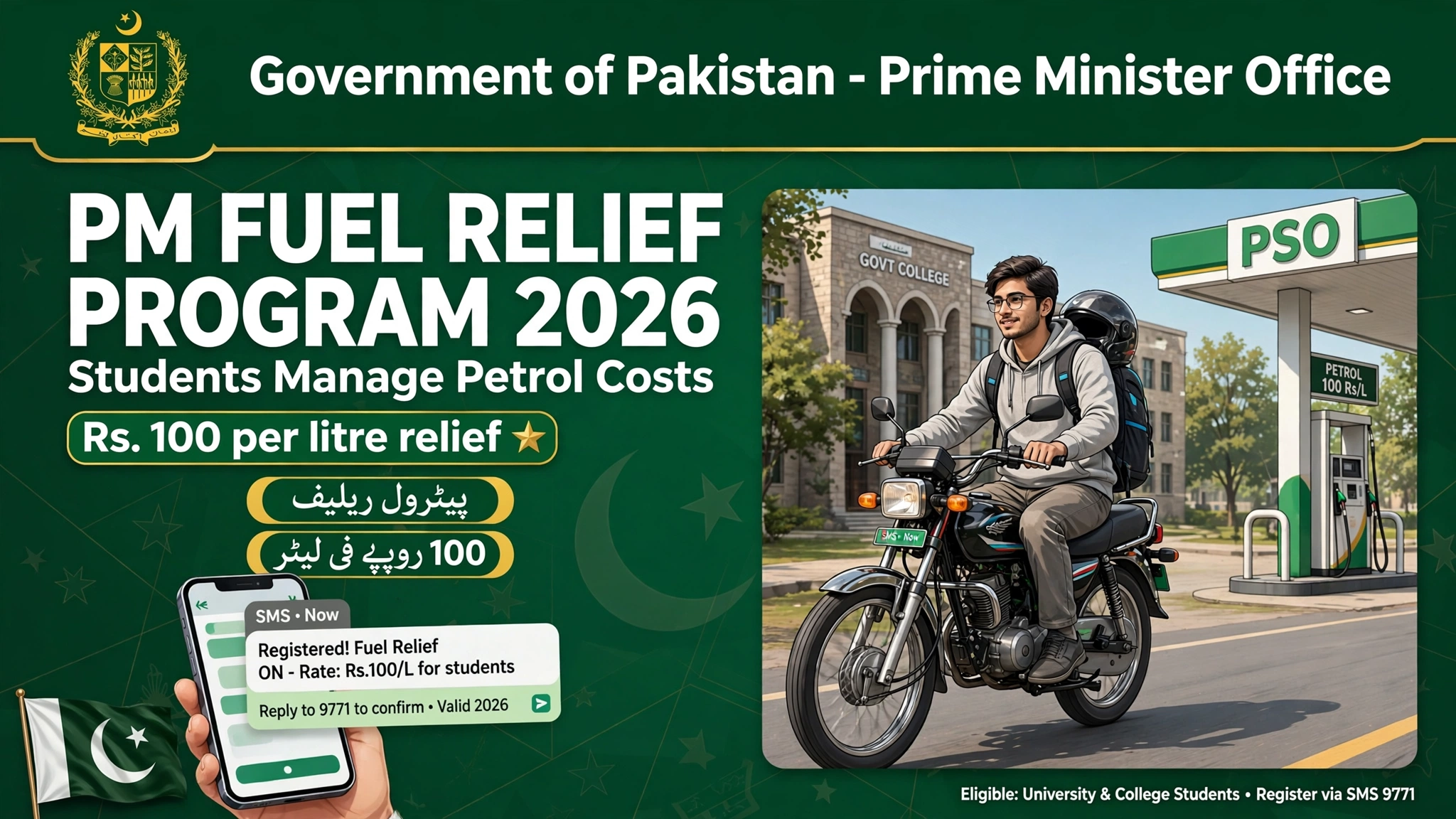
Students and young daily riders are among the biggest users of motorcycles in Pakistan. College and university students travel every day, often on tight pocket money from parents or small part-time earnings. For them, every rupee spent on petrol is a rupee taken from books, food, or savings. The PM Fuel Relief Program 2026 can be a real game-changer for students who ride daily.
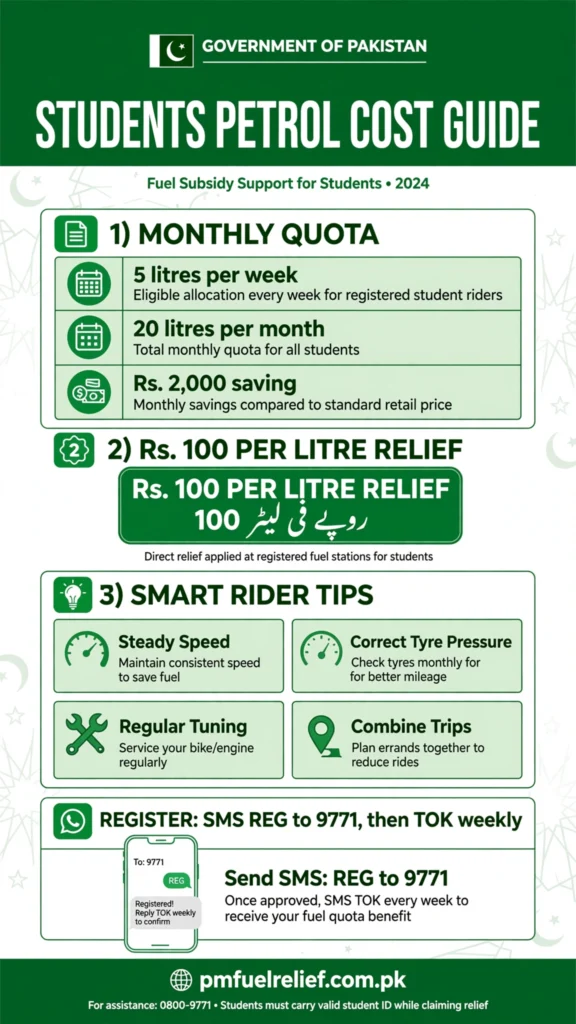
With Rs. 100 relief per litre and a 20-litre monthly quota for bikes, a student rider can save up to Rs. 2,000 every month. This article explains how students and daily riders can register, plan their weekly tokens, and manage petrol costs smartly.
| Student Rider Benefit | Monthly Value |
|---|---|
| Weekly token fuel | 5 litres per week |
| Monthly quota | 20 litres per month |
| Relief per litre | Rs. 100 |
| Maximum monthly saving | Rs. 2,000 |
| Registration cost | Free via 9771 SMS |
Why Students Struggle Most With Petrol Costs
Unlike salaried workers, most students do not earn a fixed income. They depend on a monthly allowance from their family, which rarely increases when petrol prices rise. A student travelling 20 km daily to college spends a painful share of this limited allowance on fuel alone.
- Fixed pocket money means no cushion against price hikes.
- Daily college travel is compulsory, not optional.
- Part-time jobs pay little, and fuel eats into those earnings.
- Many students also run family errands on the same bike.
For such riders, the weekly 5-litre token is not just a discount. It is the difference between attending classes comfortably and worrying about fuel money every week. Official program details are listed on pmfuelrelief.pk.
How Students Can Register for PM Fuel Relief 2026
Registration is simple, but students must note one important rule: the SIM used for registration must be registered in the applicant’s own name, and the applicant needs a valid CNIC. Young riders who recently turned 18 and hold a CNIC can register themselves.
Send an SMS to 9771 in this format: REG CNIC Plate-No Province-Code Registration-Date. The bike must be registered, and its details verified through the Excise record. Students riding a family-owned bike should check whose name the registration carries, because the applicant’s CNIC and vehicle record must match. After approval, the weekly routine is the same: send TOK to 9771 each week for the 5-litre token.
Planning Weekly Tokens Around College Schedules
College weeks are predictable, which makes token planning easy for students. Most students attend classes five or six days a week, with a fixed timetable.
- Monday: Generate the weekly token and refuel before classes.
- Weekdays: Use token fuel for college and tuition travel.
- Weekend: Remaining fuel covers family errands or part-time work travel.
- Exam season: Extra library trips fit easily, since study travel is usually short.
- Holidays: Light travel weeks mean the token stretches even further.
A student travelling 15 km daily uses roughly 2 litres a week. The 5-litre token therefore covers college travel with plenty left over. This surplus can support a part-time delivery job in the evening, effectively letting the student earn more without extra fuel cost.
Smart Fuel Habits for Young Riders
Young riders can stretch their weekly token much further with a few smart habits. These habits also make riding safer, which parents will appreciate.
- Maintain a steady speed; racing the bike burns fuel twice as fast.
- Service the bike regularly; a clean air filter alone improves mileage noticeably.
- Keep tyre pressure correct; soft tyres are a hidden fuel thief.
- Combine trips: finish bank, market, and college work in one round.
- Avoid unnecessary idling outside college gates or shops.
Students who ride sensibly often report getting 60 or more kilometres per litre. At that mileage, the weekly 5-litre token covers 300 kilometres, which is more than enough for college plus a part-time job. More student-focused guidance is available on pmfuelrelief.com.pk.
| Student Daily Travel | Weekly Fuel vs 5-Litre Token |
|---|---|
| College 8 km away (16 km daily) | About 2 litres – token more than enough |
| College + tuition 25 km daily | About 3 litres – token covers fully |
| College + part-time job 40 km daily | About 5 litres – token just covers |
| University 30 km away (60 km daily) | About 7 litres – extra fuel needed |
| Hostel student, weekend home trips | About 3 litres – token easily covers |
Using Saved Money Wisely as a Student
The Rs. 2,000 monthly saving is significant money for a student. It makes sense to give this saving a purpose instead of letting it disappear into small daily spending.
Many students use the saving for exam fees, books, or a better internet package for online study. Others save it for a future goal, like a laptop or a skill course. Some help their parents with household expenses, which builds trust and often leads to more support for their own needs. Whatever the choice, treating the fuel relief as a small monthly scholarship keeps its value visible and meaningful.
What Daily Riders With Long Routes Should Do
Not every young rider has a short commute. Delivery riders and those travelling to distant universities may need more than 5 litres a week. The program still helps them greatly, even if it does not cover everything.
- The weekly token cuts Rs. 500 off the fuel bill every week, whatever the total use.
- Extra fuel beyond the token is bought at the normal price; there is no penalty.
- Delivery riders can treat the token as covering their first 5 litres, the most expensive part of the week.
- Combining the token with fuel-saving habits shrinks the extra amount needed.
Even for heavy users, Rs. 2,000 monthly relief is real money that stays in the pocket instead of going to the petrol pump.
Conclusion
Students and young daily riders face petrol costs on limited pocket money, making the PM Fuel Relief Program 2026 especially valuable for them. The 20-litre monthly quota, delivered as four weekly 5-litre tokens, covers the full college commute of most students and saves up to Rs. 2,000 every month. Registration through 9771 is free and one-time, and the weekly TOK routine takes two minutes. With sensible riding habits and simple weekly planning, students can turn fuel relief into meaningful savings for education and personal goals.
Frequently Asked Questions
Can a student without a job register for the program?
Yes, if the student holds a valid CNIC, owns or is linked to a registered bike, and has a SIM in their own name. Income is not a condition; vehicle eligibility is what matters.
My college is only 8 km away. Is the quota still useful?
Very useful. Short travel means your 5-litre weekly token will have surplus fuel, which you can use for family errands or part-time work without extra cost.
What if my bike is registered in my father’s name?
The applicant’s CNIC and vehicle record must match official records. Check the Excise record and register with the details exactly as they appear there.
Can the Rs. 2,000 saving really cover my monthly petrol?
For most students travelling under 30 km daily, yes. The 20-litre quota at Rs. 100 relief per litre typically covers the full month of college travel.