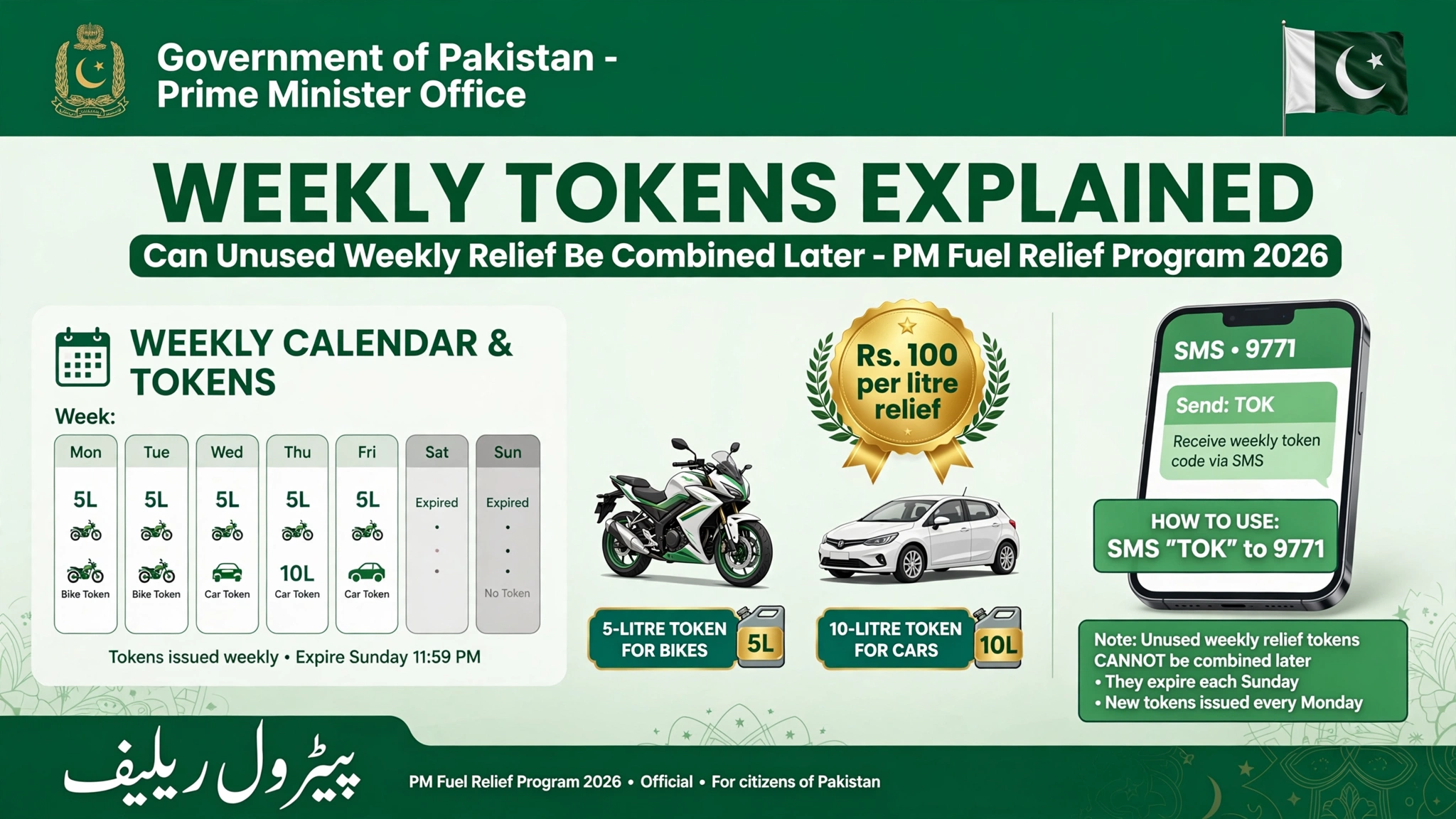
The PM Fuel Relief Program 2026 divides the monthly fuel quota into weekly tokens. Bike owners get 5-litre tokens and car owners get 10-litre tokens. A very common question from applicants is: if I do not use this week’s relief, can I combine it with next week’s and take more fuel later?
This article explains how the weekly token system is announced to work, why combining is generally not possible, and what you should do instead. As always, confirm the latest rules on pmfuelrelief.pk.
| Question About Combining | Short Answer |
|---|---|
| Can 2 bike tokens combine into 10 litres at once? | The announced system issues fixed 5-litre bike tokens per use |
| Can 2 car tokens combine into 20 litres at once? | The announced system issues fixed 10-litre car tokens per use |
| Does skipped relief add to next week? | Each token covers its own fixed quantity; skipped weeks are not added up |
| Best approach | Use each token in its week to get the full monthly benefit |
| Where to confirm | Official announcements on pmfuelrelief.pk and 9771 messages |
How Weekly Tokens Are Designed
Weekly tokens keep the relief spread evenly through the month. Instead of giving 20 or 30 litres at once, the program releases the quota in small portions.
- Bike, rickshaw and Qingqi owners: 5 litres per token, four tokens a month.
- 800cc car owners: 10 litres per token, three tokens a month.
- Each token is generated separately by sending TOK to 9771.
- Each token is used for its fixed quantity at the petrol pump.
- The design assumes one token per week or per ten-day period.
This structure is deliberate. It stops the quota from being finished in the first days of the month and keeps support available all month long.
Why Tokens Cannot Be Combined Into Bigger Amounts
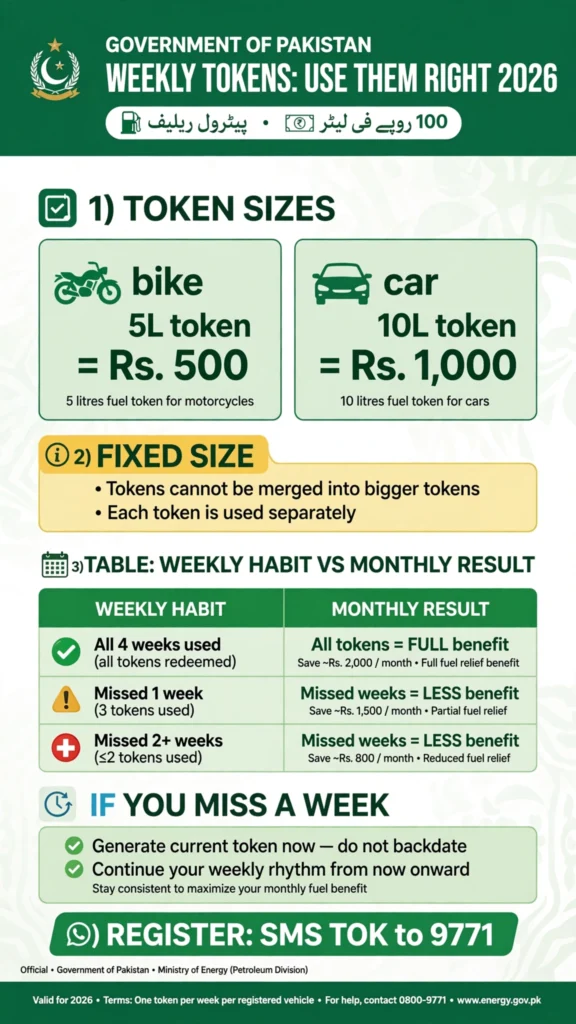
According to the announced program structure, a token has a fixed size. A bike token is always 5 litres and a car token is always 10 litres. The petrol pump system is set up to accept one token for one fixed quantity.
Combining would mean changing the token size, which the announced system does not provide for. If you skip a week, that week’s 5 or 10 litres simply remain unused for that period. The next token you generate will again be the standard fixed size, not a doubled one.
Examples: What Combining Would Look Like vs Reality
Imagined combining: A bike owner skips week 1 and week 2, then takes 20 litres at once in week 3. This is not how the announced token system works.
Reality: The bike owner generates one 5-litre token at a time. If weeks 1 and 2 are skipped, only weeks 3 and 4 tokens can still be used, giving 10 litres or Rs. 1,000 instead of Rs. 2,000.
Car example: A Mehran owner cannot merge two 10-litre tokens into a single 20-litre fill. Each visit uses one 10-litre token. Skipped tokens mean a smaller monthly total. More guidance is available on pmfuelrelief.com.pk.
Smart Ways to Use Every Week’s Relief
Since combining is not the way, the smart move is never letting a token go unused.
- Set a fixed day each week for generating your token through 9771.
- Even if your tank is half full, take the token fuel and adjust next week’s travel.
- Coordinate with family members who share the vehicle so tokens are always used.
- Keep the vehicle documents and SIM active so token generation never fails.
- Track used tokens in a notebook to see your monthly progress.
Regular small use beats irregular big use under this system.
| Weekly Habit | Monthly Result |
|---|---|
| Bike: token every week, all 4 used | 20 litres, full Rs. 2,000 benefit |
| Bike: tokens in weeks 1 and 4 only | 10 litres, only Rs. 1,000 benefit |
| Car: token every ten days, all 3 used | 30 litres, full Rs. 3,000 benefit |
| Car: tokens in first two periods only | 20 litres, only Rs. 2,000 benefit |
| Any vehicle: no tokens generated | Zero benefit despite being registered |
What To Do If You Missed a Week
Missing a week is not the end of the world. Focus on the remaining weeks instead of trying to recover the lost one.
- Generate the current week’s token immediately through TOK to 9771.
- Continue the normal weekly rhythm for the rest of the month.
- Do not wait for a “double token” option that is not announced.
- Note the reason you missed, such as travel or vehicle repair, and plan better next month.
- Register any complaint about token failure through official helpline channels.
Each new week is a fresh chance to claim that week’s portion.
Staying Updated on Token Rules
Governments sometimes refine program procedures after launch. Any change to token sizes or timing would be announced officially.
- Read updates on pmfuelrelief.pk before believing forwarded messages.
- Keep the official 9771 SMS responses; they confirm your token status.
- Ask at participating petrol pumps only about the current token process.
- Never pay anyone who promises to “combine” or “increase” your tokens.
Official sources are the only reliable guide for token rules.
Conclusion
Unused weekly relief under PM Fuel Relief 2026 generally cannot be combined later into bigger fuel takes. The announced system issues fixed tokens of 5 litres for bikes, rickshaws and Qingqis and 10 litres for 800cc cars, each used separately through 9771. Skipping a week reduces that month’s total benefit instead of adding to the next week. The practical answer is simple: generate and use every token in its week, track your tokens, and follow official announcements for any rule changes.
Frequently Asked Questions
Can I take 10 litres at once with two bike tokens?
The announced system gives fixed 5-litre bike tokens, each used separately, so combining into larger single takes is not provided for.
If I skip a week, is that relief lost forever?
That week’s portion goes unused for the month since the quota works on a monthly cycle. Use remaining weeks’ tokens to still get a good benefit.
Can car owners combine two 10-litre tokens?
No. Each car token is fixed at 10 litres in the announced system and is used one at a time.
Who can confirm the latest token rules?
Only official sources: pmfuelrelief.pk and official 9771 SMS responses. Do not trust agents promising token combinations.