
The PM Fuel Relief Program 2026 sets two different monthly fuel limits: 20 litres for two and three-wheelers, and 30 litres for cars up to 800cc. Many applicants ask why there are two limits and which one applies to them. The answer is simple, but understanding the full comparison helps you get the maximum benefit from the scheme.
This article compares the 20 litres and 30 litres limits side by side, so you can see exactly how much relief each limit gives and how to use your quota wisely through the month.
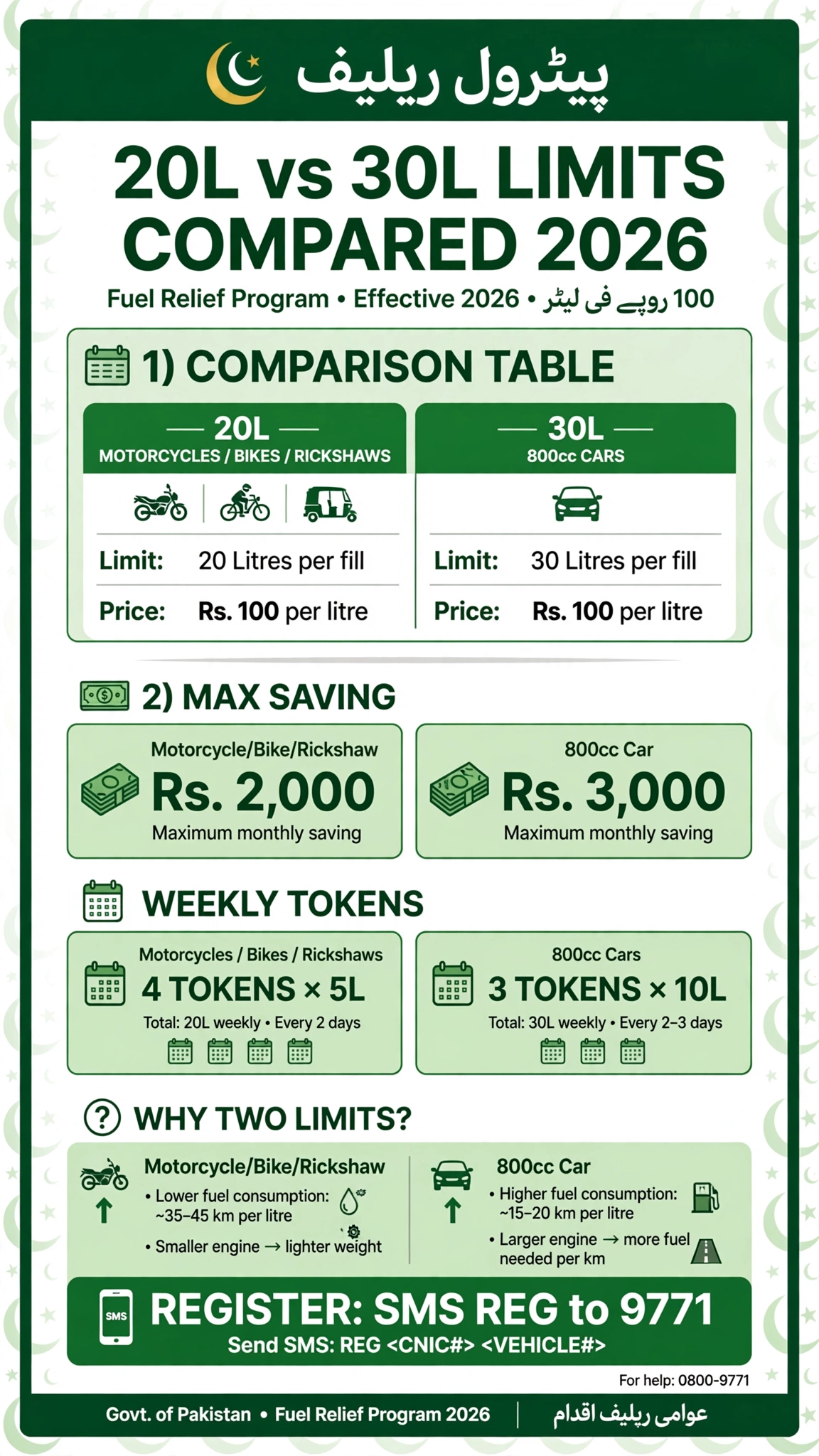
| Comparison Point | 20 Litres Limit vs 30 Litres Limit |
|---|---|
| Who gets it | 20L: motorcycles, bikes, rickshaws, Qingqis — 30L: cars up to 800cc |
| Relief per litre | Rs. 100 per litre under both limits |
| Maximum monthly saving | 20L limit: Rs. 2,000 — 30L limit: Rs. 3,000 |
| Weekly token size | 20L limit: 5 litres per token — 30L limit: 10 litres per token |
| Tokens per month | 20L limit: 4 tokens — 30L limit: 3 tokens |
Who Falls Under the 20 Litres Limit
The 20-litre monthly limit covers all two-wheelers and three-wheelers. This is the largest group of beneficiaries in the program.
- All motorcycles and bikes, including Honda CD70, CG125, Yamaha and Suzuki models.
- Auto rickshaws used for passenger transport in cities and towns.
- Qingqis operating on local routes.
- The quota gives Rs. 2,000 maximum relief per month at Rs. 100 per litre.
- Weekly tokens of 5 litres keep the relief spread across four weeks.
Since bikes consume less petrol, 20 litres is enough to make a real difference in a rider’s monthly budget without wasting government funds.
Who Falls Under the 30 Litres Limit
The 30-litre monthly limit is reserved for small cars. The engine size must be 800cc or less, verified through the Excise and Taxation record.
- Suzuki Mehran, the most common small car in Pakistan, is fully eligible.
- Suzuki Alto in its 660cc and 800cc versions qualifies under the limit.
- Suzuki Bolan, widely used for family and goods transport, is included.
- The quota gives Rs. 3,000 maximum relief per month at Rs. 100 per litre.
- Weekly tokens of 10 litres suit the higher fuel use of cars.
Cars burn more fuel per kilometre, so the extra 10 litres keeps the support fair between bike and car owners. Full details are available on pmfuelrelief.com.pk.
Why the Program Has Two Different Limits
Some people feel the two limits are unfair, but there is a clear reason behind them. A motorcycle gives 40 to 50 kilometres per litre, while a small car gives only 14 to 18 kilometres per litre. This means a car needs almost three times more petrol to cover the same distance.
If both got 20 litres, car owners would get very little real help because their monthly use is much higher. If both got 30 litres, bike owners would receive more than they need. The two limits balance the support so that each group gets meaningful relief according to its actual fuel consumption.
Weekly Breakdown of the 20 and 30 Litre Quotas
The monthly quota is divided into weekly tokens. Here is how each limit spreads across the month.
- 20-litre limit: four tokens of 5 litres each, roughly one token per week.
- 30-litre limit: three tokens of 10 litres each, roughly one token every ten days.
- Send TOK to 9771 to generate a token whenever you need fuel.
- Each token is used at the petrol pump for that fixed quantity at the relief rate.
- Try to use tokens evenly so the quota supports you for the full month.
Planning token use week by week prevents the common mistake of finishing the whole quota in the first few days.
| Week of the Month | How Each Limit Is Used |
|---|---|
| Week 1 | 20L group: 5-litre token — 30L group: 10-litre token |
| Week 2 | 20L group: 5-litre token — 30L group: no token needed yet |
| Week 3 | 20L group: 5-litre token — 30L group: 10-litre token |
| Week 4 | 20L group: 5-litre token — 30L group: 10-litre token |
| Month total | 20L group: 20 litres, Rs. 2,000 saved — 30L group: 30 litres, Rs. 3,000 saved |
Real Examples: 20 Litres vs 30 Litres in Daily Life
Consider two neighbours. Imran rides a motorcycle 30 km daily to his shop. He uses about 1.5 litres a day, nearly 40 litres a month. His 20-litre quota saves him Rs. 2,000, cutting his fuel bill almost in half.
His neighbour Tariq drives a Mehran 30 km daily for office. He uses about 2.5 litres a day, nearly 70 litres a month. His 30-litre quota saves him Rs. 3,000. Both travel the same distance, but the car needs more fuel, so the higher limit keeps Tariq’s support proportional to his cost.
How to Check Which Limit Applies to You
Finding your limit is easy if you follow these steps.
- Check your vehicle type: two or three wheels means the 20-litre limit.
- Check your car engine size on the registration book: 800cc or less means the 30-litre limit.
- Confirm your vehicle record with the Excise and Taxation Department before registering.
- Send your REG SMS to 9771 with correct CNIC, plate number, province code and registration date.
- After confirmation, your tokens will follow the limit of your vehicle category.
For official updates about quotas and limits, visit pmfuelrelief.pk.
Conclusion
The PM Fuel Relief Program 2026 gives a 20-litre monthly limit to motorcycles, bikes, rickshaws and Qingqis, worth up to Rs. 2,000 in relief, and a 30-litre monthly limit to cars up to 800cc, worth up to Rs. 3,000. Both limits give Rs. 100 relief per litre and are delivered through weekly tokens of 5 and 10 litres. The two limits exist because cars consume more fuel per kilometre than bikes. Knowing which limit applies to your vehicle helps you plan tokens across the month and get the full benefit.
Frequently Asked Questions
Can a bike owner ever get the 30-litre limit?
No. The 30-litre limit is only for cars up to 800cc. Two and three-wheelers always fall under the 20-litre limit.
What if my car is 1000cc?
Cars above 800cc are not eligible for the program at all, so neither limit applies to them.
Do both limits use the same registration method?
Yes. Everyone registers by sending the REG SMS to 9771 with CNIC, plate number, province code and registration date.
Is the Rs. 100 per litre relief the same for both limits?
Yes. The relief rate is Rs. 100 per litre for every eligible vehicle. Only the monthly litre limit is different.